
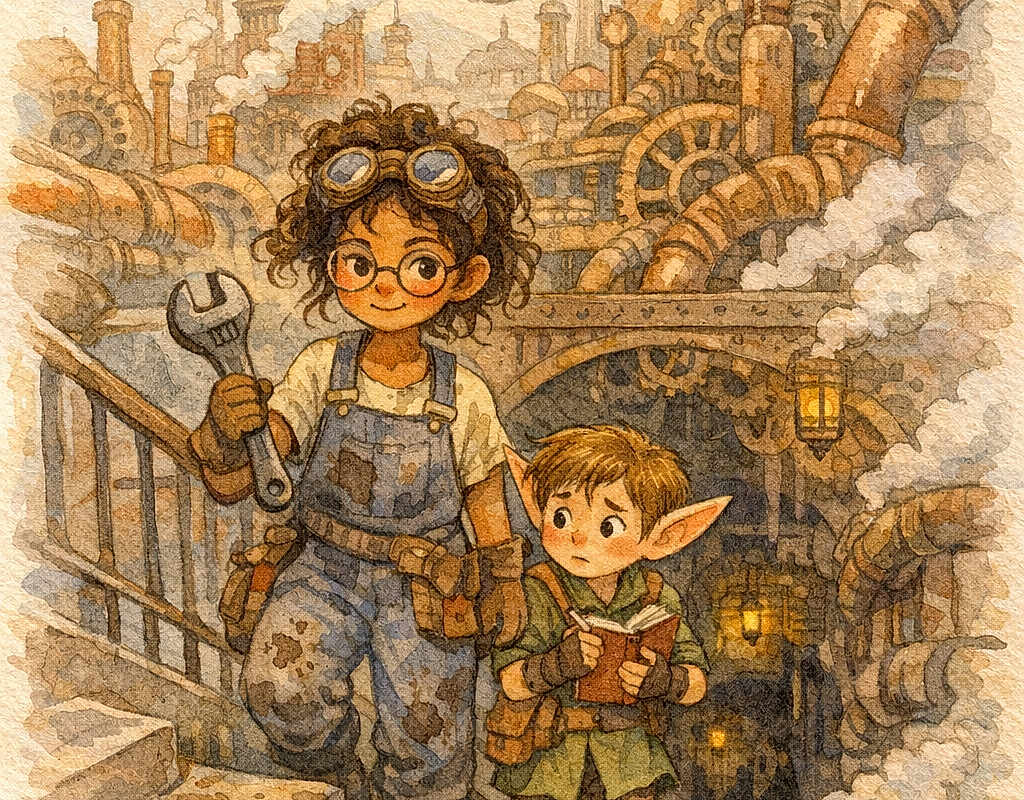
Mariam Morba had lived all her life in the Steampunk City of Brasshaven, where the streets were paved with slate and the air always smelled faintly of warm oil and cinnamon from the turbine-bakeries. Above the rooftops, pipes braided like vines, and clocktowers blinked with copper eyelids. Even the pigeons wore tiny brass rings, as if the city itself insisted on being polished.
Mariam was a girl with quick hands and a quicker mind, an inventor-in-training who loved taking broken things apart just to learn the secrets inside them. She wasn’t loud about it; she was the kind of brave that looked like listening carefully, like waiting, like planning. When people argued, Mariam tended to step back and watch—until she saw the one small action that could change everything.
On the first snowless morning of Winterweek, Mariam carried a satchel of gears to the Workshop District, where pipes exhaled steady sighs and the ground vibrated with the rhythm of machines. She had promised herself she would not get distracted by the Holiday Parade preparations—especially not by the jingling airships that hovered like metallic whales above the Avenue of Rivets.
But the city was already buzzing. Posters fluttered on every lamppost: WELCOME SANTA TO BRASSHAVEN! GRAND ARRIVAL TONIGHT! In the corner of each poster was a small illustration of Santa’s sleigh, a strange sight in a city where everything usually ran on steam and cogs.
Mariam frowned. “How does a sleigh even land on the Gearbridge?” she muttered.
A voice behind her said, “With style, apparently.”
She turned. A tall person in a long coat stood there, carrying a notebook so thick it looked like it had eaten other notebooks. Their pen was tucked behind an ear. Their eyes were bright, like they’d been awake for three ideas too many.
“I’m the Story Author,” they said, as if that explained everything.
Mariam blinked. “The… what?”
“The one who writes down the adventure as it happens,” the Story Author replied. “Or tries to. Brasshaven is noisy. My ink trembles when the steam whistles.”
“That sounds inconvenient,” Mariam said.
“It’s thrilling,” the Story Author corrected, and scribbled something. “And you, Mariam Morba, are exactly the sort of girl who notices the inconvenient parts and turns them into solutions.”
Before Mariam could ask how a stranger knew her name, the air split with a cheerful bell-like laugh. Something small zipped past her head and landed on the rim of a nearby smokestack.
An elf.
Not a toy-store elf, not a picture-book elf—this one wore a soot-resistant green coat with too many pockets, goggles pushed up into messy hair, and boots that left tiny prints shaped like stars in the grime. The elf waved both arms.
“Mariam! Finally! You have to come! It’s a situation!”
Mariam stiffened. “Do I know you?”
The elf hopped down with a springy landing. “Name’s Pip. Santa’s helper, part-time mechanic, full-time emergency enthusiast.” Pip leaned in and lowered their voice. “Santa lost something. And if we don’t find it before night, Brasshaven’s Holiday Parade is going to… well… it’s going to go wrong in an interesting way. Not the kind you want.”
Mariam’s heart did a small, worried flip. “What did he lose?”
Pip glanced around, then tapped Mariam’s satchel of gears. “Something like that, but not exactly. The North Star Cog.”
“The what?” Mariam asked.
“The North Star Cog,” Pip repeated, as if saying it louder might make it make sense. “It’s the little gear that helps Santa’s sleigh navigate. Not just directions—stories. It points to the place where the most needed gift should go. Without it, Santa can fly, but he’ll drift. He’ll deliver the wrong things to the wrong people. Imagine getting a trumpet when you need a blanket, or a fancy puzzle box when you really need a new coat.”
Mariam pictured her neighbor, Old Mr. Brill, who shivered in his drafty flat but always smiled anyway. He did not need a trumpet. He needed a coat. “That’s… actually serious.”
The Story Author made a delighted little noise and wrote faster. “A quest! A lost item! Excellent. A city of gears meets a gear of destiny.”
Mariam narrowed her eyes. “So where’s Santa? And why is an inventor-in-training being recruited for this?”
Pip pointed toward the Grand Station, where enormous glass domes covered platforms like bubbles. “Santa’s inside. He’s… trying not to panic.”
Mariam looked at the elf’s sooty coat and trembling hands. Pip was acting cheerful, but worry leaked out anyway.
“Fine,” Mariam said. “I’ll help. But if this is a prank, I will redesign your boots to squeak.”
Pip gasped. “Cruel.”
They hurried through the bustling streets. Brasshaven was dressed for Winterweek: ribbons of copper foil hung between lampposts, clockwork birds chirped carols, and vendors sold roasted chestnuts served in tiny paper cones with gear-shaped stamps.
At the Grand Station, a crowd pressed against velvet ropes. Steam drifted along the ceiling like pale ghosts. Somewhere, a choir of children practiced a song that kept getting interrupted by the honk of a mechanical swan float.
Pip ducked under the rope, and Mariam followed, slipping through like a shadow. The Story Author strolled behind them as if ropes were merely suggestions.
Inside a private waiting room, Santa sat on a bench reinforced with iron. He looked exactly like the stories said he would—red suit, white beard, eyes that could be gentle and sharp at the same time. But he also looked like he’d spent the last hour in a machine shop: a smear of grease crossed his glove, and his hat was tilted as if it had been tugged.
When he saw Mariam, he stood quickly. “Ah! You must be Mariam Morba.”
Mariam tried not to stare. “Yes, sir.”
Santa’s voice softened. “Thank you for coming. I’m sorry to pull you into this right before the parade.”
Pip blurted, “It’s my fault! I was adjusting the sleigh’s steam stabilizers and then the platform shook and then—”
Santa held up a hand. “Accidents happen. What matters is what we do next.” He turned to Mariam. “The North Star Cog is missing. Without it, my sleigh can still move, but it can’t… choose well. It can’t feel the city.”
Mariam looked at the sleigh through the window: an old-fashioned shape fitted with Brasshaven modifications—steam valves, pressure dials, a small boiler that puffed politely. “Where did you last see the Cog?”
Santa sighed. “On the sleigh’s navigation plate. Then there was a crash—something heavy fell in the cargo bay—and when we checked, the plate was empty.”
The Story Author leaned forward. “Heavy? Like a crate?”
Santa nodded. “A crate from the city’s gift foundry. It was supposed to be loaded after my inspection, but it arrived early.”
Mariam’s mind started clicking like teeth of a gear. Early crates, sudden crash, missing Cog. “So someone could have taken it during the confusion.”
Pip’s face went pale. “You mean… stolen?”
Santa’s eyes flicked toward the crowd outside, full of smiling people who expected wonder. “I don’t like to suspect, but… yes. And there is more. The air around the sleigh felt colder afterward. Not winter-cold. Wrong-cold.”
Mariam swallowed. In Brasshaven, cold usually came from drafty vents, not from “wrongness.” “Do you have enemies?”
Santa’s mouth tightened. “There are creatures that dislike joy. And there are others that simply want what they should not have.”
At the word creatures, Pip’s goggles slipped down a little as if gravity had increased.
Mariam glanced at the Story Author. “Are you going to help, or just write?”
The Story Author looked offended on paper’s behalf. “I can do both. I’m excellent at noticing narrative clues.” They tapped their notebook. “Also, I packed sandwiches.”
Santa approached Mariam and held out a small brass compass. It wasn’t ordinary; instead of directions, the face showed icons: a mitten, a candle, a heart, a wrench. The needle quivered.
“This is the Kindness Compass,” Santa said. “It doesn’t point north. It points toward need. It might help you track the Cog, because the Cog also follows need. If someone stole it, the compass may tug toward them.”
Mariam took it carefully. The brass was warm, as if it had been near a hearth. “I’ll return it.”
“I know,” Santa said.
Pip bounced once. “Where do we start?”
Mariam thought of the crash. “We start at the sleigh. We look for evidence.”
They slipped into the cargo bay where the sleigh was being tuned by city mechanics. The mechanics wore leather aprons and spoke in a language of hisses and clicks. When Santa waved, they stepped back politely.
Mariam climbed into the sleigh, careful not to snag her scarf on the valves. She knelt by the navigation plate. A circular imprint showed where the North Star Cog had sat, surrounded by tiny scratches.
She traced them with a finger. “These scratches are fresh. They go outward, like someone pried it out with a thin tool.”
Pip groaned. “So it was stolen.”
The Story Author crouched beside Mariam. “And it was intentional. That changes the tone.”
Mariam pointed to a smear on the plate: a dark, sticky residue that smelled faintly of burnt sugar and metal. “What’s that?”
Santa’s expression tightened. “Soot-glue. Used by certain… less friendly beings.”
Pip whispered, “Monster.”
Mariam’s stomach did another flip, but this time she held it steady. “Where would a Monster hide in Brasshaven?”
Pip’s voice came small. “Down below. In the Underworks.”
Everyone in Brasshaven knew about the Underworks: the older tunnels beneath the city, where forgotten pipes ran, where old machines were left to rust, where steam pooled in low chambers like fog. Adults told kids not to go there, and kids pretended they wouldn’t, which meant they absolutely would if dared.
Mariam wasn’t here for dares. She was here for the North Star Cog.
The Kindness Compass in her hand twitched. Not toward the bright station exit. Down. Toward the service stairs that led under the platforms.
“That’s our direction,” Mariam said.
Santa put a hand on her shoulder—heavy, steady. “Be careful. The Underworks remember what people forget.”
The Story Author’s pen paused. “That’s a terrific line,” they said.
Santa blinked. “I meant it as a warning.”
“It can be both,” the Story Author replied.
They found a maintenance door marked AUTHORIZED ONLY. Pip produced a keyring the size of their head.
“Don’t ask,” Pip said, already unlocking it.
The stairwell smelled of damp stone and old steam. Their footsteps echoed. Above, the city’s music became a distant hum, like a lullaby heard through walls.
Mariam clicked on a small lamp from her satchel—a gear-lantern she’d built herself. It shone with a steady amber light.
As they descended, the Kindness Compass needle jittered, as if nervous.
“Is it… supposed to do that?” Pip asked.
Mariam listened to the faint clank of pipes. “It’s picking up a lot of need. The Underworks are full of forgotten things.”
The tunnel opened into a wide corridor lined with old boilers like sleeping beasts. Steam drifted in ribbons. Somewhere, water dripped with patient rhythm.
Then they heard it: a low scraping sound, like a shovel dragging across metal.
Pip swallowed loudly. “That’s not normal Underworks music.”
They followed the sound, passing rusted signs and abandoned control panels. Mariam noticed something else: tiny footprints in the dust, irregular, heavy at the heel.
“Monster tracks,” Santa murmured.
The Story Author whispered, “This is where the suspense increases.”
Mariam shot them a look. “Please stop narrating out loud.”
“I can’t help it,” the Story Author said, but lowered their voice.
The corridor widened into a chamber where an enormous gear lay on its side, half-buried like a fallen moon. A faint blue glow pulsed behind it.
Mariam crept forward and peeked around the gear.
The Monster was there.
It was not the kind of Monster with neatly labeled weaknesses. It was tall, hunched, built of shadow and scraps—bits of broken metal, torn velvet, and old ribbons. Its eyes were like furnace doors with a dim fire behind them. And in its clawed hand, it held a small star-shaped gear: the North Star Cog.
The Cog glimmered with a light that didn’t belong underground. It flickered as if trying to remember the sky.
Mariam’s throat tightened. “We need to get it back.”
Pip whispered, “How? That thing looks like it eats optimism.”
Santa’s voice was calm, but Mariam could hear steel in it. “Monsters don’t eat optimism. They eat attention. Fear. The more you feed it with panic, the larger it feels.”
The Monster turned its head slowly, as if it had heard them anyway. Its furnace eyes narrowed.
The Kindness Compass needle spun wildly.
Mariam forced herself to breathe. She had fixed broken clocks by not rushing. She could fix this, too.
She stepped out from behind the gear.
Pip grabbed her sleeve. “Mariam, no!”
Mariam gently pulled free. “Yes. But carefully.”
The Monster’s voice, when it spoke, sounded like wind through a cracked pipe. “Who… comes… for my star?”
Mariam kept her lamp raised, not like a weapon but like a statement: I see you. “I’m Mariam Morba. That Cog isn’t yours.”
The Monster’s claws tightened around the star gear. “It was… dropped. Forgotten. Like me.”
Santa stepped beside Mariam. “Nothing about you is forgotten. Not truly. But you can’t keep what guides gifts. That will hurt people.”
The Monster made a sound that might have been a laugh, if laughter could be rusty. “People… never come down here. They never bring gifts to the Underworks. Only scraps. Only leaks.”
Mariam understood something then: the Monster wasn’t just stealing to be cruel. It was stealing to be seen.
The Story Author whispered, “Nuance. Excellent.”
Mariam did not look away from the Monster. “If you want to be seen, stealing the North Star Cog won’t help. It will make everyone chase you with anger.”
The Monster’s eyes flickered. “I like… being chased. It proves… I exist.”
Mariam’s brain clicked again. “Then let’s make a different proof.” She reached into her satchel and pulled out a small device: a pocket projector made from a lens and a hand-cranked dynamo.
Pip hissed, “Is that one of your inventions?”
Mariam nodded. “I use it to test light patterns in clockfaces.”
She held it up. “Monster, do you know what people do during Winterweek? They watch the parade. They look up. They cheer. They see lights.”
The Monster leaned forward slightly, suspicious.
Mariam continued, “If you return the Cog, I’ll build you something. A Beacon Mask. It will glow—bright enough that people above will notice. Not fear. Notice.”
The Monster’s claws paused.
Santa’s eyebrows lifted. Pip’s mouth opened, then closed, then opened again as if Pip’s thoughts were bumping into each other.
The Story Author scribbled furiously. “A bargain! A clever one!”
The Monster’s voice rumbled. “Lies. All lies. They will look and then… turn away.”
Mariam’s heart thumped hard, but she stayed steady. “Maybe some will. But not all. And I won’t. I’ll come down here myself to check the Beacon.”
The Monster’s furnace eyes flickered again, like a flame deciding whether to catch.
Pip whispered, “Mariam, what if it takes you and—”
Mariam whispered back, “Then I’ll have to be even more clever.”
She turned the projector’s crank and aimed it at the wall behind the Monster. A soft image bloomed: the streets of Brasshaven at night, lights strung between towers, the parade floats moving like glittering animals. Mariam had recorded it last year through her workshop window.
The Monster stared. The glow on the wall painted its shadow in gentler shapes.
Santa stepped forward, voice warm. “You can have gifts too, you know. Not scraps. Real ones.”
The Monster’s claws trembled. “Gifts… are for the above.”
Mariam took a careful step closer. “Gifts are for anyone who needs them. That’s what the Kindness Compass says.” She glanced down; the needle pointed directly at the Monster, steady now.
Pip made a small noise. “Oh.”
The Monster’s voice softened into something like a confession. “I was… made from forgotten parts. The city throws away what it breaks. I gathered it. I grew.”
Mariam nodded slowly. “Then you’re part of Brasshaven, too.”
The Monster looked at the star gear, then at the projected parade, then at Mariam’s lamp.
“Give… me proof,” it said. “A gift… now.”
Santa reached into his coat and pulled out a small parcel wrapped in brown paper with a red string. “I always carry a few,” he said quietly, as if to himself.
He held it out.
The Monster recoiled. “Trick.”
Mariam spoke gently. “Let me open it first.”
Santa nodded.
Mariam took the parcel, unwrapped it, and revealed a small brass music box shaped like a gearflower. She turned the key. A clear melody chimed—soft, brave, like a lantern in fog.
The Monster’s furnace eyes widened. The fire inside them brightened, not with rage but with something almost painful.
“Mine?” it whispered.
Santa nodded. “Yours.”
The Monster’s claw brushed the music box, careful as if it expected to burn. The melody continued. The Monster’s shoulders sagged.
Slowly, slowly, it extended the other claw and set the North Star Cog on the ground between them.
Mariam did not snatch it. She waited. Then she slid it toward herself with the edge of her boot.
Pip exhaled so hard their goggles fogged.
The Story Author whispered, “A peaceful resolution with a material reward. Wonderful structure.”
Mariam picked up the Cog. It felt lighter than she expected, like holding a promise.
The Monster clutched the music box. “Beacon… mask?”
Mariam nodded. “I’ll build it. Not a mask that hides you. A mask that shows you.”
Santa added, “And I will make sure the Underworks receive something, too. Warm blankets. Lantern fuel. A repair crew. The forgotten parts will be collected, not thrown.”
The Monster looked between them, uncertain, like it was learning a new kind of language.
Mariam tucked the Cog into her satchel, wrapped in cloth. “We should go. Santa has a parade.”
As they turned to leave, the Monster called softly, “Mariam Morba.”
She paused.
“Thank you… for not shouting.”
Mariam nodded once. “Thank you for listening.”
The climb back up felt shorter, as if the Underworks had loosened its grip. When they emerged into the Grand Station, the noise hit them like sunlight. The crowd was thicker now, faces glowing with excitement.
Pip jogged beside Mariam. “You were amazing. Also terrifying. Also amazing.”
Mariam’s cheeks warmed. “I was mostly improvising.”
“That’s the best kind of bravery,” Santa said, overhearing.
They reached the sleigh. The mechanics hurried to reinstall the North Star Cog. Mariam watched closely as it clicked into place, fitting perfectly, as if it had always belonged there.
The Kindness Compass needle settled, calm.
Santa tested the navigation plate. The star gear spun once, and the air around the sleigh brightened, like the city itself had taken a deep breath.
A cheer rose outside as someone announced Santa’s official arrival.
Santa turned to Mariam. “You returned what was lost. You also gave something new.”
Mariam opened her mouth to say she hadn’t built the Beacon Mask yet, but Santa raised a finger.
“Not just an object,” Santa said. “A chance.”
The Story Author snapped their notebook shut with a satisfied thump. “And now the ending must include a reward,” they said briskly, as if consulting rules.
Santa chuckled. “Agreed.” He reached into his coat again and pulled out a second package, heavier than the first. This one was wrapped in red paper stamped with a tiny gear-and-star seal.
“For you,” Santa said. “Because Brasshaven needs inventors who can negotiate with Monsters and still notice scratch marks.”
Mariam hesitated. “I… didn’t do it for a present.”
Santa’s eyes twinkled. “That’s precisely why you deserve one.”
Mariam took the package and unwrapped it carefully. Inside was a compact toolkit made of polished brass and dark wood, the tools nested like sleeping birds: a micro-wrench set, a foldable magnifier, insulated wire, a pocket solderer, and—most surprising—a small blueprint scroll tied with silver thread.
She unrolled the scroll. The design showed a machine unlike anything she’d seen: a portable beacon generator meant to shine through fog and smoke, powered by kindness-heat rather than coal. At the bottom, in neat handwriting, were the words: FOR MARIAM MORBA, FUTURE MASTER ENGINEER OF WONDER.
Mariam’s throat tightened in a different way than before. “This is… incredible.”
Pip peeked over her shoulder. “That’s like… legendary-level equipment.”
The Story Author nodded solemnly. “A tangible treasure that also supports character growth. Perfect.”
Mariam looked up at Santa. “Can I use this to build the Beacon Mask for the Monster?”
Santa’s smile widened. “That is exactly what it’s for.”
Outside, the parade drums began. Brasshaven’s clocktowers chimed in harmony. Santa climbed into the sleigh, and Pip scrambled up after him.
Before Santa took the reins, he leaned down to Mariam. “One more thing. If you ever need help—if the city feels too loud, or the Underworks too dark—remember you can ask. You don’t have to fix everything alone.”
Mariam nodded, absorbing that like a tool she hadn’t known existed.
The sleigh’s boiler puffed. The North Star Cog spun, casting a brief spray of starry light over the station ceiling. The crowd roared.
As the sleigh lifted, Mariam stepped back, clutching her toolkit. The Story Author stood beside her.
“Well,” the Story Author said, “I’d call that a successful chapter.”
Mariam watched the sleigh disappear into the wintery haze above the glass dome. “It’s not finished,” she said.
“Oh?”
Mariam’s eyes shifted toward the maintenance door that led down. “I promised a Beacon Mask.”
Pip’s voice echoed faintly from above, carried on the air: “Don’t forget to make it extra bright!”
Mariam smiled—small, but real. She headed toward her workshop, already planning. The Beacon Mask would be light enough not to burden the Monster, sturdy enough for the damp tunnels, and bright enough to be seen from the Avenue of Rivets.
That night, as the parade glittered through Brasshaven and Santa’s sleigh swept between smokestacks like a comet, a new light began to glow from below the city.
Not frightening.
Not hidden.
Just a steady, coppery star—proof that even in a place of forgotten parts, someone could be found.
And in her workshop, Mariam Morba tightened a final screw on her new invention, her hands sure, her courage quiet, and her future as bright as any gear-shaped constellation.