
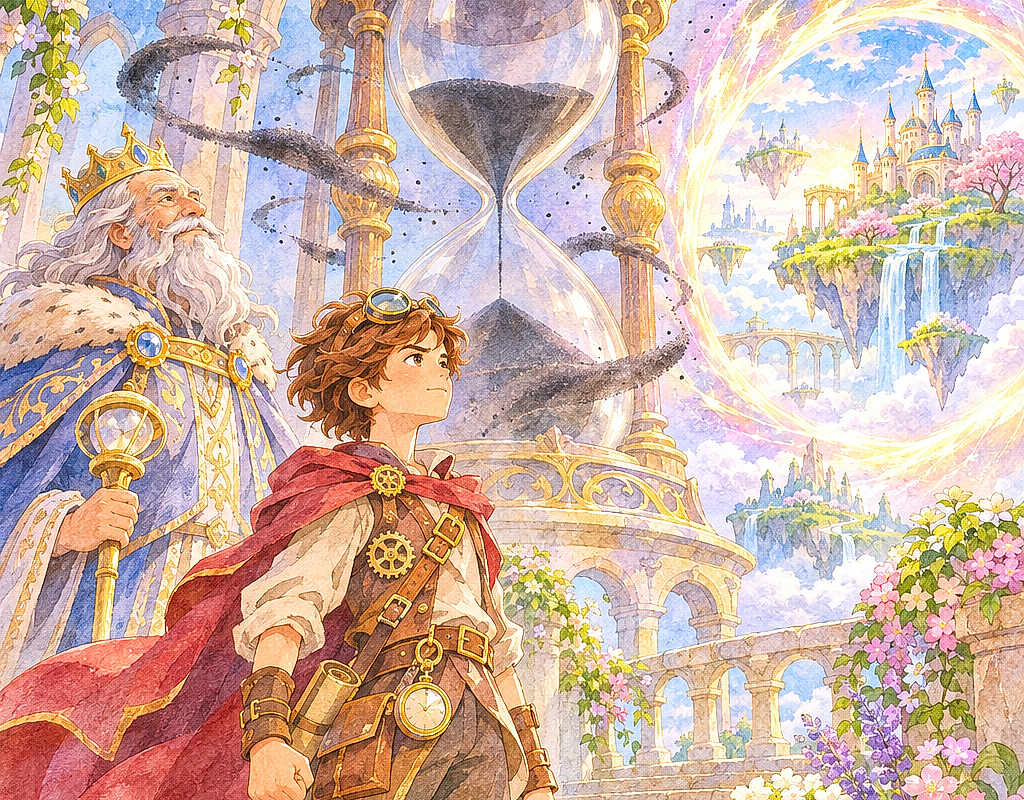
Owen was a Time Traveler, though he did not wear a cape made of clock faces or carry a suitcase full of thunder. He wore a brown apron with six pockets, mismatched socks, and a pair of round goggles that always slipped down his nose.
His time machine was hidden inside the royal workshop, behind a shelf of wooden ducks. It looked like an ordinary brass alarm clock from the outside. But when Owen wound its silver key backward and whispered, “Minutes, mind your manners,” the clock opened like a flower. Inside were tiny levers, glowing gears, and a steering wheel no bigger than a teacup saucer.
The workshop stood beside King Aldren’s castle. It was a splendid, cluttered place, crowded with half-built kites, clockwork birds, wagons without wheels, and jars of screws sorted by color. The King often visited in his crown, though he sensibly took it off before leaning over any whirring machine.
King Aldren was famous for making careful decisions. He listened to bakers, gardeners, children, and even the castle cat before choosing what to do. Yet when he was worried, he polished his royal boots until they shone like black mirrors.
On the morning of the Festival of First Light, Owen found the King polishing both boots at once.
“Your Majesty,” Owen said, “that is either very impressive or very worrying.”
“It is worrying,” said the King. “The Great Hourglass has stopped.”
Owen pushed up his goggles. Everyone in the kingdom knew about the Great Hourglass. It stood in the Clock Tower, and its golden sand marked the beginning of the festival each year. When its last grain fell, lanterns were lit, musicians played, and the sky filled with bright paper balloons.
“But it is only an hourglass,” said Owen.
The King gave him a grave look. “Not this one. Its sand keeps the kingdom’s little moments in order. Breakfast follows waking. Seeds remember to sprout. Stories reach their endings. If it stays stopped, time may begin tripping over its own feet.”
Just then, a spoon flew out of a drawer, circled the workshop, and landed in Owen’s pocket.
“Time has already begun,” Owen said, “to trip.”
A cold whisper drifted through the open window.
“Tick… tock… take your time…”
Every clock in the workshop froze. The cuckoo in the wall clock poked out its head and said, “Cuck—” before stopping with its beak open.
In the silence appeared Fantom.
He was not quite a person and not quite a shadow. He wore a coat made of midnight mist, and his face shimmered like a reflection in dark water. Two pale blue lights watched from beneath his wide hat.
King Aldren reached for the ceremonial bell at his belt, but Fantom raised one smoky finger.
“No bells,” he sighed. “No festival. No rushing, cheering, marching, baking, dancing, or waiting for sand to fall. Today, everything may be still.”
“Why?” asked Owen. His voice shook a little, but he planted both feet firmly on the floor.
Fantom’s blue eyes dimmed. “Because time takes everything away. A warm cake becomes crumbs. A summer becomes a memory. A child becomes too large for a favorite swing. If time stops, nothing has to leave.”
With a swish of his misty coat, Fantom vanished. On the worktable he left a black grain of sand, cold as an ice cube.
King Aldren looked toward the Clock Tower. “The Great Hourglass is frozen by shadow-sand.”
Owen studied the grain with a magnifying glass. Inside it, he saw a tiny picture: three doors in a circle. One showed a sunrise, one showed a moon, and one showed a bright spinning gear.
“A time puzzle,” he said. “Fantom has broken the hourglass into three moments and hidden its heart.”
The King’s worried hands stopped polishing. “Can your little machine take us there?”
Owen glanced at the brass clock. He had traveled to yesterday once, by accident, and spent twenty minutes trying to convince himself not to eat an entire pie. He had never carried a king through time.
“It can,” he said at last. “But a Time Traveler needs a steady helper. Someone who can tell a brave idea from a silly one.”
“I am excellent at that,” said King Aldren. “Most silly ideas involve juggling turnips.”
“Not all of them,” Owen replied. “Some involve traveling through time.”
They packed three cheese rolls, a coil of golden thread, Owen’s screwdriver, the royal bell, and a tiny folding map of the kingdom. The King tried to bring a large velvet chair.
“For dignity,” he explained.
“There is not room,” said Owen.
“A small cushion, then?”
Owen nodded. “For emergency dignity.”
He wound the silver key backward. The workshop stretched long and thin, as if it had become a picture painted on a rubber band. Gears sang. The brass clock opened. Owen and the King squeezed inside, knees against elbows, and Owen spun the tiny steering wheel.
“First stop,” he said, “the moment before the first sunrise ever reached our valley.”
The machine gave a cheerful ding, then a very rude wobble.
They landed on a hill beneath a sky of deep violet. The valley below was dark and quiet. Even the river seemed to be holding its breath. On the horizon sat the sun, round and golden, but it could not rise. A huge clockwork gate blocked its path.
At the gate stood Fantom, holding a key shaped like a sunbeam.
“You cannot open it,” he said. “The gate asks a question no clock can answer.”
Golden letters appeared in the air:
WHAT GROWS LARGER WHEN YOU SHARE IT, YET VANISHES WHEN YOU KEEP IT ONLY FOR YOURSELF?
The King scratched his chin. “A cheese roll?”
Owen considered this. “A cheese roll gets smaller when shared.”
“That depends on the appetite of the people sharing it.”
Fantom gave a tiny, almost hidden smile. “Think, Time Traveler.”
Owen watched the dark valley. He remembered the workshop apprentices helping each other find tools. He remembered how the King listened, even to the smallest voices. Then he looked at Fantom, alone in the enormous dawn.
“Hope,” Owen said. “Hope grows when you share it. If you hide it all for yourself, it disappears.”
The clockwork gate clicked. It opened its wings with a roar of gears, and the sun rolled slowly into the sky. Warm light spilled over the valley, turning the river silver and the grass bright green.
The sunbeam key flew from Fantom’s hand and became a glowing grain of gold. Owen caught it in a glass vial.
“One piece,” said the King.
Fantom’s mist swirled uneasily. “Hope can hurt,” he murmured. “It makes you expect mornings.” Then he vanished.
The brass clock machine waited on the hill, its hands spinning. Owen and the King climbed back inside.
“Second door,” said Owen. “The moon.”
This time they arrived in the royal workshop again—but it was not their workshop. It was the same room many years in the future. The benches were dusty. The wooden ducks had faded. A crack ran across Owen’s favorite blue tool chest.
Owen swallowed. “I do not like this moment.”
At the center of the workshop floated a moonlit bubble. Inside it was a little boy, perhaps six years old, sitting alone beside a broken toy train. His shoulders were shaking.
Fantom stood near him, less tall than before. “This is the night my train broke,” he said quietly. “I had waited all year for it. My father promised to repair it. But he had to leave on a long journey, and he never came back.”
The King’s face softened. “I am sorry.”
Fantom stared at the bubble. “I wanted time to stop before that night could end. Before I had to understand that some things do not return.”
Owen’s first wish was to grab a wrench, leap into the bubble, and repair the train. But the little boy did not need only a train. He needed someone beside him.
Owen stepped forward. “Can we enter?”
Fantom hesitated, then nodded.
The bubble opened with a pop. Owen and the King became small enough to stand on the workbench beside the boy. The toy train had a loose wheel and a bent silver pin.
“Hello,” said Owen gently. “I am Owen. This is King Aldren.”
The boy sniffed. “Are you really a king?”
“I am,” said King Aldren. “But at the moment, I am mostly a person looking for a screwdriver.”
The boy pointed to one. “There.”
“Ah,” said the King. “You have rescued the kingdom already.”
While Owen carefully straightened the pin, the King sat beside the boy. He did not say that everything would be fine, because sometimes that sentence felt too big and slippery. Instead, he said, “It is very sad when a person you love cannot be there.”
The boy nodded.
“My father taught me to polish boots,” the King added. “Whenever I miss him, I polish them badly on purpose. It reminds me that he would laugh.”
The boy gave a small laugh. Owen slid the wheel back onto the train. He wound the key. The train puffed a thread of blue smoke and chugged in a circle around the bench.
The boy clapped. Then the moonlit bubble began to glow from within. A silver grain floated upward.
“You did not erase the sad moment,” Fantom whispered. “You stayed in it.”
“Sad moments need company too,” Owen said.
Fantom took the silver grain, but instead of hiding it, he placed it in Owen’s open palm.
“Two pieces,” said the King.
The future workshop began fading. Before it disappeared, Owen noticed something new on the dusty wall: a painted sign reading OWEN’S WORKSHOP FOR MARVELOUS REPAIRS. Under it were drawings of children, old people, birds, and one rather proud-looking king.
Owen smiled. “That is a future I would like to visit properly.”
Their final journey was the most difficult. The gear door led not to a place in the past or future, but to the Space Between Seconds. Owen called it that because no map had a name for it. The Time Traveler’s clock shook as it crossed a tunnel of floating numbers. Mondays drifted by like blue fish. Lost minutes buzzed like fireflies. Somewhere, a forgotten sneeze echoed.
They landed on a bridge made of enormous clock hands. Below it stretched a sea of swirling darkness. At the far end stood the heart of the Great Hourglass: a crystal chamber containing the final grain, bright as a star.
But Fantom was there first.
“I cannot let you take it,” he said. He was no longer frightening in the same way. He looked tired, like a shadow after a very long day. “If you restore the hourglass, everything will change again. The festival will end. The lanterns will burn out. The children will go home. You will grow older. I will lose every moment I try to hold.”
The bridge began to crack beneath them.
King Aldren stepped forward, though his knees were clearly not enjoying the situation. “Fantom, a festival ending does not make it worthless. A lantern going out does not mean it never shone.”
“Easy for a king to say,” Fantom snapped. “You have a castle full of people.”
The words struck the King silent.
Owen looked at the bright final grain. He could jump for it. His Time Traveler boots had springy heels, and he was fairly sure he could make the leap. But Fantom might fall into the Sea Between Seconds. Winning by leaving someone behind did not feel like winning.
Then Owen noticed the royal bell in the King’s pocket.
“Your Majesty,” he said, “may I borrow your bell?”
The King handed it over.
Owen rang it once. The sound was clear and warm. It did not race forward or backward. It simply stayed where it was, shining in the air.
Fantom flinched.
“That sound,” he said. “My father had a bell like that.”
“Then let us listen,” Owen replied.
He rang it again. This time the sound became a picture: a small kitchen, a laughing father, and a young Fantom holding up a toy train. The picture did not trap the moment. It let it pass gently through the air, like a paper boat on a stream.
“You have not lost it,” Owen said. “You remember it. Memories are not cages. They are bridges. You can walk across them whenever you need to.”
Fantom’s pale blue eyes filled with tiny stars. The cracks in the bridge stopped spreading.
“But I do not know how to let time move,” he admitted.
“You do not have to do it alone,” said King Aldren.
For a moment, nobody moved. Then Fantom reached toward the crystal chamber. His smoky fingers touched the star-bright grain. The chamber opened.
The third grain floated into Owen’s hands.
At once, the three grains—golden, silver, and star-bright—began circling one another. They joined with a chiming sound and formed a single drop of shining sand.
“Quickly!” cried Owen. “Back to the Clock Tower!”
The Time Traveler’s clock was battered, and one of its tiny gears had fallen out during the crossing. Owen fixed it with his screwdriver, the golden thread, and, after much debate, half a cheese roll used as a cushion. The King held the steering wheel steady. Fantom wrapped the machine in mist to shield it from the wild rushing seconds.
Together they flew through the tunnel of time.
They arrived in the present with a bump that knocked the royal cushion onto Owen’s head. Outside, the kingdom was still frozen in a strange jumble. Pigeons hung in the air above the square. A baker stood with flour suspended around his nose. A little girl’s red balloon floated without rising or falling.
The Clock Tower door was sealed by shadow, but Fantom stepped forward.
“I made this,” he said. “I should unmake it.”
He placed both hands on the dark door. The shadow melted away into harmless gray dust.
Inside, the Great Hourglass towered from floor to ceiling. Its top chamber was full of golden sand, but nothing fell through its narrow middle. A black knot of shadow-sand blocked the passage.
Owen climbed a ladder with the shining drop in one hand. Halfway up, the ladder shook. King Aldren grasped its base. Fantom rose beside Owen, holding the rungs steady with swirls of cool mist.
At the top, Owen pressed the drop into a small star-shaped hollow. The hourglass flashed. The black knot resisted, twisting into the shape of a snarling face.
“No endings!” it hissed.
Owen was afraid. He could feel it in his knees, in his hands, and in the quick flutter of his heart. But he remembered the dark valley waiting for dawn, the lonely boy beside the train, and Fantom choosing to help.
“Endings make room for beginnings,” Owen said.
King Aldren rang the royal bell.
Fantom added, “And memories keep what matters close.”
The knot burst into a shower of tiny black grains. Before they could fall, Fantom lifted them in a gentle spiral. They changed into soft gray seeds and drifted out the tower window toward the castle garden.
Then the first grain of golden sand fell.
Tink.
The sound rolled across the kingdom.
Pigeons flapped onward. Flour landed on the baker’s nose, and he sneezed so enormously that three loaves jumped from the oven. The red balloon bobbed into the blue sky. Every clock began ticking, each in its own cheerful voice.
In the square, people cheered. The Festival of First Light began at last.
King Aldren placed a hand on Owen’s shoulder. “Owen, Time Traveler and chief repairer of impossible things, you have saved our moments.”
Owen’s cheeks turned pink. “We saved them. Also, Fantom did excellent mist work.”
Everyone looked at Fantom. He hovered uncertainly near the tower door, as if expecting the crowd to be angry.
A little girl with the red balloon marched up to him. “Do you like festivals?” she asked.
“I have not liked one for a very long time,” Fantom answered.
“Then you should try this one,” she said. “There are honey cakes.”
Fantom blinked. “Honey cakes?”
“They are sticky,” she warned.
“I have survived shadow-sand,” said Fantom. “I can face sticky.”
By sunset, the kingdom glowed with lanterns. Musicians played fiddles and drums. The King danced with such serious concentration that Owen had to pretend to inspect a nearby lantern so he could laugh politely. Fantom discovered that when he spun quickly, his mist made the lantern flames curl into beautiful shapes: dragons, rabbits, sailing ships, and once, accidentally, a very large dancing turnip.
“It is dignified,” King Aldren insisted, watching it twirl.
At the end of the festival, the King led Owen back to the workshop. On the worktable stood a new treasure chest made of polished oak. Its lock was shaped like a clock face.
“For you,” said the King.
Owen opened it. Inside lay a magnificent tool kit: silver screwdrivers, copper gears, a compass that pointed toward problems needing kindness, and a pair of new Time Traveler goggles with blue glass lenses. Beneath them was a small brass badge engraved with the words ROYAL KEEPER OF HAPPY HOURS.
Owen touched the badge as if it might vanish.
“And there is one more thing,” said the King.
Fantom floated from behind the shelf of wooden ducks. In his hands was Owen’s time machine. He had polished the brass until it gleamed.
“I repaired the dent,” Fantom said. “I hope that was allowed.”
Owen examined it. The machine now had a tiny new lever beside the steering wheel. A label read: RETURN TO A GOOD MEMORY.
“It is perfect,” Owen said.
Fantom looked down. “May I visit the workshop sometimes? I am learning that I do not need to freeze a good moment to keep it.”
Owen grinned. “You may visit whenever you like. But you have to help sort screws by color.”
Fantom made a dramatic groan. “A terrible fate.”
The King put his crown back on, though it sat slightly crooked after all the dancing. “It is settled, then. Tomorrow we build a shelf for the new tool kit. And perhaps a second shelf for honey cakes.”
“In a workshop?” Owen asked.
“Emergency honey cakes,” the King replied.
The three of them laughed. Outside, the Great Hourglass sent its golden sand softly falling, one shining moment after another. Owen knew that some days would be busy, some would be sad, and some would be so wonderful that he would wish they could last forever.
But now he knew something important. Time was not a thief carrying moments away. It was a traveler too, carrying them onward, where they could become stories, memories, inventions, and reasons to begin again.
Owen wound the silver key forward one little turn. The clock gave a happy ding. In the warm, bustling workshop, with his new badge shining on his apron and his friends nearby, the Time Traveler was ready for whatever marvelous moment came next.