
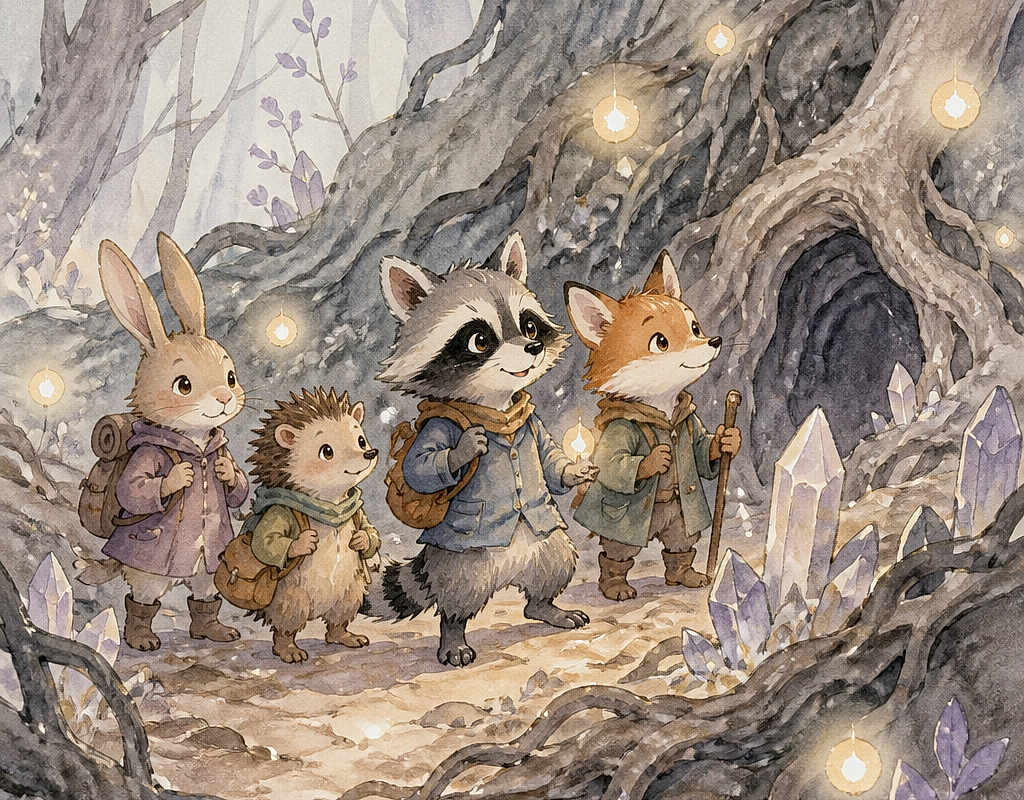
Outcast was a bandit, though not the sort who stole purses from travelers or hid treasure beneath a black hat. He was a small silver-furred raccoon with a blue scarf, clever paws, and a reputation for appearing wherever something had gone missing. A lost button, a runaway spoon, a pie cooling on a windowsill: if it vanished, the animals of the Enchanted Forest would whisper, “Ask Outcast.”
They called him Outcast because he lived at the very edge of the forest, beyond the bright mushroom paths and the cozy burrows. Years before, he had accidentally set off every tinkling alarm-bell in the Moonberry Market while trying to return a stolen necklace. The necklace had belonged to Mayor Badger, the bells had belonged to everyone, and the startled market had assumed the worst. Outcast had never forgotten the suspicious looks.
So he kept mostly to himself in an old hollow oak. He made useful things from bits and bobs: a lantern from a jar and glow-worm glass, a rain hat from a giant leaf, and a tiny wheeled cart for carrying found objects home. He did not complain much. Still, whenever he heard laughter drifting from the village, his ears drooped a little.
One morning, the Enchanted Forest woke without its colors.
The red foxes were gray. The violets were pale as old paper. Even the sunrise had turned the color of weak tea. Only shadows remained properly dark, slipping between trunks like spilled ink.
Outcast stared from the doorway of his oak. “That is not right,” he murmured.
Then he noticed something stranger: every berry on the Moonberry bushes had become clear as glass. Inside each one, a tiny curl of color swirled and tapped against the skin, as if trying to escape.
A brass bell rang from the path below.
“Outcast!” cried a breathless voice. “Outcast, please do not hide!”
It was Relic Keeper, the forest museum’s guardian. Relic Keeper was a broad-shouldered tortoise with spectacles balanced on the end of his beak and a shell painted with tiny maps. He usually walked slowly enough for snails to overtake him. Today he was moving so fast that his satchel bounced against his side.
Behind him skipped Spellcaster, a young magpie in a purple cape dotted with stars. She carried a crooked wand made of rowan wood. Its tip spat harmless green sparks whenever she was worried, which was often.
“Why are you here?” Outcast asked, trying to sound less curious than he felt.
“Because the Prism Heart has been taken from the Hall of First Things,” said Relic Keeper. “It is the ancient crystal that sends color through the roots, rivers, wings, and skies of this forest.”
Spellcaster lifted her wand. “And because the thief left a clue. A very rude clue.”
She unfolded a strip of bark. On it, in shining silver letters, were the words: FIND WHAT WAS FORGOTTEN, OR LET ALL BEAUTY FADE.
Outcast examined the bark. The silver letters smelled faintly of rain, stone, and something older than trees.
“The Ancient Guardian,” Relic Keeper said quietly.
Outcast knew that name. Every child in the forest knew it. The Ancient Guardian was said to sleep beneath the ruined arches in the deepest part of the woods, guarding treasures from the First Age. Some called it a monster with antlers of crystal. Others said it was a giant made of roots and rock. Nobody agreed, because nobody had ever returned with a clear story.
“Maybe it took the Prism Heart,” Spellcaster said, “but I do not think it is a simple thief. Its message sounds like a riddle.”
“It sounds like trouble,” said Outcast.
“It does,” Relic Keeper agreed. “And we need someone who can follow tracks that others cannot see.”
Outcast glanced toward the colorless forest. “You came to me after all these years?”
Relic Keeper’s old eyes softened. “I should have come sooner, for reasons much less frightening than this. You were blamed unfairly, Outcast. I knew it, but I did not speak loudly enough. I am sorry.”
Spellcaster’s wand gave a small blue pop. “Also, I read every detective story in the museum library. The clever bandit always gets recruited at the important moment.”
Outcast wanted to say no. He wanted to return to his hollow and pretend that gray leaves and colorless berries were none of his business. But a pale little squirrel sat near the path, staring at its once-golden tail with tears in its eyes.
Outcast tightened his blue scarf. “Show me the Hall.”
At the Hall of First Things, the empty pedestal gleamed beneath a broken glass dome. There were no muddy footprints, no claw marks, and no sign of forced locks. Yet Outcast crouched, sniffed, and found three nearly invisible specks on the floor: one white feather, one grain of blue sand, and one drop of honey.
“Someone traveled through the hall,” he said, “but not someone who wanted us to know.”
“A feather?” Spellcaster asked. “Could it be me?”
“You have black-and-white feathers,” Outcast said. “This one is silver.”
Relic Keeper adjusted his spectacles. “Blue sand comes from the Whispering River. Honey comes from the bees of Lantern Meadow.”
“Then our thief went in three directions at once,” said Spellcaster.
“Or left three clues on purpose,” said Outcast. He picked up the feather carefully. Along its shaft were tiny scratched marks. “Look. These are not scratches. It is a map.”
The marks formed a line from Lantern Meadow to the Whispering River, then into the tangled northern woods. At the end was a small drawing of a door beneath a crescent moon.
They had barely stepped outside when a voice called from a branch overhead. “If you are going north, you will need better shoes and less panic.”
A tall figure dropped lightly onto the path. It was Nomad, a young deer with a patched traveling cloak, golden eyes, and a pack so full that it seemed impossible for him to stand upright. Nomad had journeyed farther than any creature in the forest. He knew where rivers changed their minds, where clouds slept, and which caves echoed lies.
“I heard the colors had gone,” Nomad said. “I also heard a tortoise was sprinting through town. I decided the news must be serious.”
Relic Keeper gave a dignified cough. “I do not sprint. I proceed with extraordinary urgency.”
Nomad smiled. “Of course.” Then he looked at Outcast. “I know a safe route to the northern woods. Well, safe-ish. There is one bridge that sings insults.”
“Does it sing helpful insults?” Spellcaster asked.
“No,” Nomad said. “But its rhythm is excellent.”
The four companions crossed Lantern Meadow first. Without color, the meadow looked sleepy and sad. The bees circled their hives without landing, unable to recognize the flowers. Outcast found the honey clue again, shining on a tall stone shaped like a finger.
Carved into the stone was a sentence: THE GUARDIAN DOES NOT TAKE. THE GUARDIAN RETURNS.
“Returns what?” Spellcaster asked.
“Perhaps the Prism Heart was not stolen,” Relic Keeper said. “Perhaps it was reclaimed.”
Outcast ran his paw over the carving. Beneath the sentence, someone had drawn a small picture of an acorn with a crack through it. He remembered a museum display: an acorn from the First Oak, kept behind velvet rope because it was supposedly empty.
“Relic Keeper,” he said. “Where is the First Oak acorn?”
The tortoise went very still. “In the Hall of First Things.”
“Was it there this morning?”
Relic Keeper’s face fell. “I did not check.”
They hurried back inside. In a glass case beside the empty pedestal sat the ancient acorn, split neatly in two. Nestled within it was a sliver of moon-white crystal.
Spellcaster gasped. “A key!”
A hidden drawer slid open beneath the case. Inside lay a round bronze compass with no needle, only a cloudy center. On its rim were the words: FOLLOW THE ONE WHO HAS NO HOME.
Nobody spoke for a moment.
Outcast stared at the compass. The cloudy center cleared, showing his own reflection.
“I do have a home,” he muttered.
“Yes,” Nomad said gently. “But you know what it is to search for one.”
Outcast did not answer. Nomad did not press him. That was one of the reasons he was easy to travel with.
The compass warmed in Outcast’s paws and pointed toward the north. The party set out again, this time with the bronze compass swinging from Outcast’s belt. At the Whispering River, they found the water silent and dull. Usually it told jokes in bubbling voices, but today it flowed without a sound.
The bridge across it was made of pale reeds. As Nomad had warned, it sang.
“Tiny paws, crooked staff!” it chimed as Outcast stepped on. “Tortoise shell, traveling draft! Deer with pockets, bird with hat! Turn around; you are too flat!”
“My cape is not a hat,” Spellcaster snapped.
“It is both,” sang the bridge.
Outcast nearly laughed, but the compass began to spin. Beneath the bridge, in a pocket of reeds, he saw something glimmering: a silver feather like the first clue. He climbed down and found a small nest woven from river grass. Inside was a shivering baby moon-owl, its feathers gray except for one bright silver wing.
“Oh!” Spellcaster whispered. “The feather did not belong to a thief.”
The moon-owl peeped and pointed with its beak toward the north shore. Tied to its nest was a thread of glowing mist, leading into the brambles.
“Someone left it here safely,” Outcast said. “The Guardian, perhaps.”
They followed the thread to a narrow trail. Along the way they found more strange, careful acts: a hedgehog sheltering beneath a rock roof that had been placed over its burrow, lost field mice guided back to their family by bright stones, and a fallen sapling lifted away from a rabbit warren.
“The Guardian has been helping,” said Nomad.
“Or arranging a very confusing plan,” said Spellcaster.
At last they reached the Door Beneath the Crescent Moon. It was set into a cliff draped in roots. Above it, a curved white stone made a moon shape. The door had no handle, only four shallow hollows: one shaped like a feather, one like a compass, one like a wand, and one like a shell.
“I dislike doors that expect visitors to solve them,” Spellcaster said.
“Try asking politely,” suggested Relic Keeper.
Spellcaster cleared her throat. “Dear Door, may we enter?”
Nothing happened.
Outcast inspected the hollows. “They do not want our things. They want what the things mean.” He looked at the others. “The feather means care for something small. The compass means finding the way. The wand means making change. The shell means remembering.”
“But how do we put those into a door?” Nomad asked.
Outcast thought of the baby moon-owl. He placed the silver feather in the first hollow. Spellcaster touched her wand to the second and whispered, “May we find the true path.” Nomad laid the compass in the third, then Relic Keeper pressed one painted map from his shell against the fourth.
The door remained closed.
“It needs all four meanings,” Outcast said. “Not just objects.”
Relic Keeper bowed his head. “I remember when this forest treated Outcast unfairly. I cannot change the past, but I can tell the truth now.”
Nomad said, “I have traveled everywhere because I was afraid to belong anywhere. Today I choose to stay beside my friends.”
Spellcaster said, “I use magic when I want to look impressive. Today I will use it to help, even if it goes wrong.”
Outcast swallowed. The door waited.
“I am good at finding what is lost,” he said. “But I have been hiding because I thought nobody wanted to find me. I will stop hiding.”
Warm light filled the four hollows. The roots uncurled, and the door opened with a sigh like a mountain waking.
Beyond lay a cavern so enormous that it held its own weather. Tiny clouds drifted near the ceiling. Stone trees rose from the floor, their branches sparkling with crystals. In the center stood the Ancient Guardian.
It was taller than the oldest oak. Its body was built from mossy stone, its antlers from clear crystal, and its eyes from two steady lanterns of amber light. The Prism Heart rested in a hollow in its chest, shining weakly. Around its feet huddled dozens of creatures: pale butterflies, gray fireflies, a rainbow snake with no rainbow left, and the baby moon-owl’s worried parents.
Spellcaster raised her wand, then lowered it. “You brought them here to protect them.”
The Guardian’s voice was deep enough to tremble dust from the cave roof. “The forest’s colors were not fading because I took the Heart. I took the Heart because it was failing.”
Relic Keeper stepped forward slowly. “Failing? But it has shone for a thousand years.”
“A thousand years of taking,” said the Guardian. “Creatures picked magic flowers without planting seeds. They bottled river songs. They chipped crystals from sacred caves. They admired the forest’s gifts, but forgot to care for their source. The Prism Heart grew tired.”
Outcast looked at the weak crystal. Fine cracks crawled through it like tiny lightning bolts.
“Can it be fixed?” he asked.
“Only with the Colors of Keeping,” replied the Guardian. “One color from a helpful act freely given, one from a brave truth, one from a shared journey, and one from a thing returned to its rightful place. I sent clues to summon those who might understand.”
Spellcaster’s beak opened. “That was your message? You could have written, ‘Please help repair the Prism Heart.’”
“I am ancient,” said the Guardian. “I write as ancient beings write.”
“That is true,” Relic Keeper admitted. “Old maps are dreadful at giving directions.”
The Guardian lowered its great head. “The four colors must be gathered before moonrise. Otherwise the cracks will close forever, and the forest will remain gray.”
Outcast’s paws tingled around the compass. “We have already done some of those things. Can the colors be found in them?”
“Look,” said the Guardian.
A small blue glow rose from the silver feather, carrying the kindness of rescuing the moon-owl. A bright gold glow lifted from the bronze compass, carrying Nomad’s choice to travel with friends. A violet spark floated from Spellcaster’s wand, carrying her promise to use magic for help. But the fourth space remained empty.
“The thing returned,” Relic Keeper whispered.
Outcast looked down. In his pocket was a small object he had found years ago: Mayor Badger’s necklace, the very necklace that had made everyone mistrust him. He had planned to return it that day, but when the alarms rang and the crowd shouted, he had run away. Afterward, shame had made him keep it hidden.
His scarf suddenly felt too tight.
“I have it,” he said.
Relic Keeper blinked. “The necklace?”
“I found it near the river long ago. I did not steal it. But I did not return it when I should have.”
No one scolded him. Nomad only said, “Then you know where it belongs.”
“We cannot get to Moonberry Market before moonrise,” said Spellcaster.
The Ancient Guardian’s amber eyes brightened. “A rightful place is not always a building. Sometimes it is the truth, given to the people who need it.”
Outcast understood. He held up the necklace. It was made of little amber beads, and even in the gray cavern it held a soft honey-colored glow.
He spoke clearly, though his voice shook. “I found this. I was afraid people would never believe me, so I hid it. That was wrong. I return it now, and I will return to the forest instead of hiding from it.”
The necklace floated from his paws. A rich amber light rose from it, warm as a sunbeam through autumn leaves. The four colors—blue, gold, violet, and amber—spiraled together and slipped into the cracks of the Prism Heart.
For one breath, nothing happened.
Then the crystal rang.
It was not a loud sound. It was a clear, beautiful note, like a glass cup being tapped by a raindrop. Color burst from the Guardian’s chest in a shining wave. It rushed through the stone trees, down the cavern walls, through the roots beneath the forest, and up into every leaf and feather above.
The butterflies became orange, blue, and white. The fireflies flashed green. The rainbow snake gave a delighted hiss as stripes of scarlet, indigo, and yellow returned from nose to tail.
Above ground, color raced across the Enchanted Forest. Red berries plumped on their stems. Purple violets lifted their heads. The Whispering River began laughing so loudly that the insulting bridge had to sing over it.
The Ancient Guardian knelt. In its enormous stone hands appeared a chest carved from silverwood. “Outcast, finder of the lost and returner of the hidden, this belongs to you.”
Inside was a treasure beyond anything Outcast expected: not piles of coins, but a set of marvelous tools. There was a golden magnifying lens that showed secret paths, a pocket map that redrew itself whenever someone needed help, a coil of moon-silk rope, and a badge shaped like a little lantern.
On the badge were the words: OFFICIAL KEEPER OF LOST THINGS.
Spellcaster clapped her wings. “That is much better than a boring medal.”
Relic Keeper smiled so widely that his spectacles slid sideways. “The Hall of First Things has a new position, if you would like it. Not locked indoors, of course. You could travel wherever you are needed.”
“And I can show you routes,” Nomad said. “Though perhaps not the bridge route. It has become very proud of its singing.”
Outcast touched the lantern badge. “I would like that,” he said. “But first, I want to visit Moonberry Market.”
When they arrived, the market blazed with color and relief. Mayor Badger rushed forward, staring at the amber necklace around his neck. Relic Keeper told the whole story, loudly and carefully, so that everyone heard: Outcast had found the necklace, had tried to return it, and had been blamed without proof.
For a moment, the market was quiet.
Then the pale squirrel whose tail was golden again stepped forward with a basket of moonberries. “Thank you for saving the colors,” she said.
A baker gave Outcast a honey bun. A family of mice brought him a tiny red cart wheel “for important detecting.” Even the bridge’s song somehow floated down the road: “Clever paws, brave heart, welcome home from gray-dark start!”
Outcast laughed. This time, he did not hide the sound.
By evening, the creatures of the Enchanted Forest gathered beneath the bright leaves. They planted new seeds, returned borrowed nest materials, and promised not to take magical gifts without giving care in return. Spellcaster made small stars dance over the tables, though one landed in the soup. Nomad taught young rabbits how to read the road by looking at moss. Relic Keeper told a story so long that three hedgehogs fell asleep halfway through it.
And Outcast stood at the edge of the celebration, where he had once stood alone. His blue scarf fluttered in the warm, colorful wind. His new badge glowed gently against his chest, and his golden lens shone from his belt.
The Ancient Guardian watched from the shadow of the trees. It did not look frightening anymore. It looked tired, kind, and very old.
“Will you return to your hollow oak?” it asked.
Outcast looked toward the market lights, his friends, and the enormous living forest beyond them. “Yes,” he said. “But it is not at the edge anymore.”
The Guardian’s lantern eyes gleamed.
And from that day on, whenever something precious went missing in the Enchanted Forest, a silver-furred bandit with a blue scarf would arrive with his clever paws, his magical tools, and a hopeful grin. He would follow the clue, solve the riddle, and bring it home.
For Outcast had learned that being alone was not the same as being an outcast. Sometimes, all it took was one brave truth, one returned treasure, and a few loyal friends to find the path back.